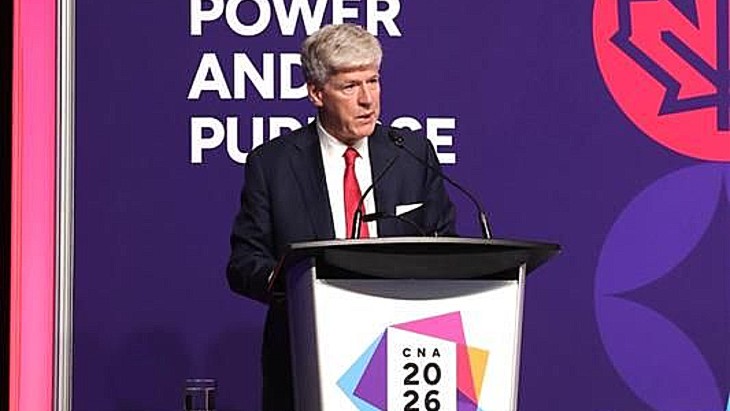
Hodgson made the announcement at the Canadian Nuclear Association Conference, which taking place in Ottawa from 28-30 April.
Citing the endorsement by 38 countries of the goal of at least tripling global nuclear capacity by 2050, Hodgson said this was a time of opportunity for Canada to grow its nuclear industry to achieve energy affordability and security at home while seizing the global opportunity of an industry that is expected to grow by up to CAD200 billion (USD146 billion) per year by 2030.
The strategy, which is being developed by Natural Resources Canada (NRCan), will build on four pillars: Enabling New Builds Across Canada; Being a Global Supplier and Exporter of Choice; Expanding Uranium Production and Nuclear Fuel Opportunities; and Developing New Canadian Nuclear Innovations (including fission and fusion).
The first pillar – enabling new nuclear builds – focuses on “building big at home in both small- and large-scale nuclear”, Hodgson said. “To do this, we must derisk nuclear investments, facilitate private and public financing, advance Indigenous partnership and prioritise projects that make economic and strategic sense.”
Under the second pillar – positioning Canada as a global supplier and exporter – the minister said Canada was “assertively pursuing a nuclear energy trade strategy that will target priority markets and support Canadian players at all levels of the supply chain as they look abroad”, leveraging “all arms of government, including the Trade Commissioner Service and Export Development Canada, to tailor our export goals to key markets with the highest chance for success”.
The third pillar will see Canada “make the most” of its uranium resources domestically, “in order to reliably meet the needs of allies’ nuclear fleet expansion with Canadian uranium”.
The fourth pillar will focus on next-generation innovation, “whether for power – such as SMRs, microreactors – or other areas, like fusion”, Hodgson said.
“We are focused on nuclear energy security and innovation from coast to coast to coast. But perhaps there is nowhere it is needed more than in our North, where bills are highest, energy security is most fragile and sovereignty is increasingly important,” Hodgson said. In recognition of this, Canada’s Defence Industrial Strategy prioritises the North, including for new, dual-use infrastructure, he said.
“Of course, that infrastructure needs power. Ideally, power that is clean, reliable and Canadian. That is why, today, I am announcing a new joint feasibility programme with the Department of National Defence and Atomic Energy of Canada Limited that will assess the potential of Canadian-controlled microreactor technology in the North.
“The Department of National Defence is investing over CAD40 million this fiscal year to examine whether next-generation microreactors can safely and reliably provide heat and electricity for remote and northern DND and Canadian Armed Forces facilities. Importantly, while this work supports defence and sovereignty in remote regions, it also has broader civilian potential and could support remote communities and other industrial sites looking for clean, dependable power.”
Recognising the underpinning role of science, research, technology and innovation for these plans, the minister noted the federal government’s commitment of CAD2.2 billion over 10 years in capital investments at the Chalk River Laboratories, Canada’s national nuclear labs, including the new Advanced Materials Research Centre and other critical infrastructure across the campus.
“Nuclear energy is central to our future, whether you are talking about our economy, our security, our climate or our role in the world,” he said. “The scale of the global opportunity is massive, but it is not one by which we should be intimidated.”
Today, 17 CANDU reactors in Ontario and New Brunswick generate about 13% of Canada’s electricity and the nuclear energy sector adds CAD22 billion annually to the Canadian economy, according to NRCan. The nation produced about 24% of total global uranium output in 2024. About 90% of its uranium production is exported to fuel nuclear power plants.