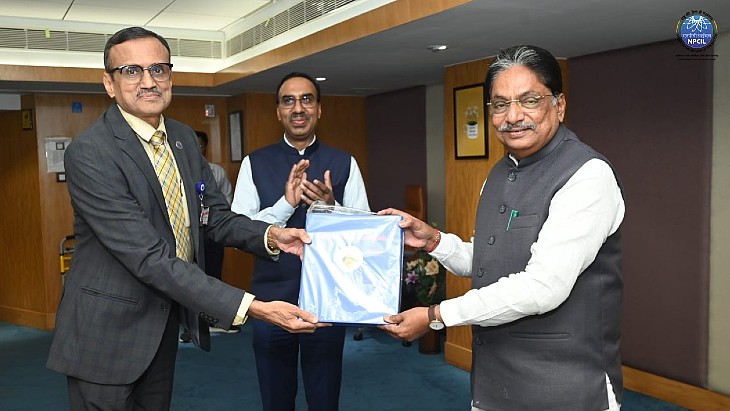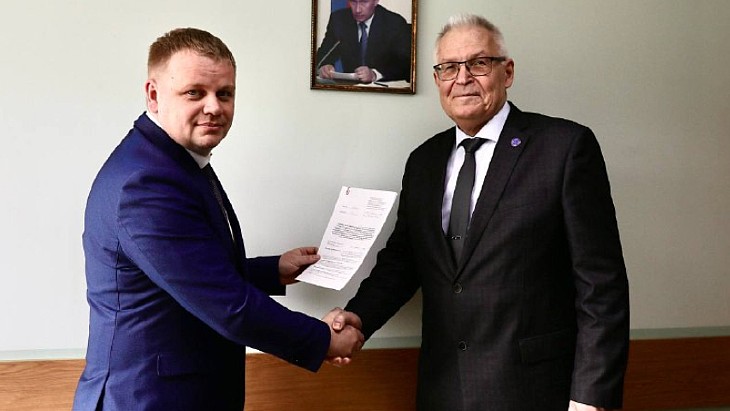
The certificate, presented by Andrey Tyurin, Acting Head of the Don Interregional Territorial Administration for Nuclear and Radiation Safety, to Kursk Nuclear Power Plant Director Alexander Uvakin, (see picture above), signifies that Kursk Nuclear Power Plant II’s first new unit meets the requirements of technical regulations and design documentation.
Rosenergoatom, part of Russia’s state nuclear corporation Rosatom and operator of the country’s nuclear power plants, said the document confirms the unit’s full readiness for commissioning and market entry, adding: “Our power unit is ready for safe and stable operation throughout its entire planned service life.”
The 1,250 MWe unit was connected to the grid in December. During pilot operation there were a series of checks and tests at each capacity level before it was allowed to increase in steps to 100% capacity, which it reached last month. During pilot operation the new unit has already generated more than a billion kilowatt-hours of electricity.
Background
Kursk II is a new nuclear power plant in western Russia, about 60 kilometres (37.5 miles) from the Ukraine border, that will feature four of the new VVER-TOI reactors, the latest version of Russia’s large light-water designs. They have upgraded pressure vessels and a power rating of 1,250 MW.
Construction of the first unit began in 2018, its polar crane was installed in October 2021 and the reactor vessel was put in place in June 2022. Concreting of the outer dome of the first unit was completed in August 2023. The second unit is also under construction and the target is for all four units to be in operation by 2034.
Rosatom says the service life of the main equipment has doubled, and that the VVER-TOI units feature a mix of passive and active safety systems and include a core meltdown localiser. The new units at Kursk II will replace the four units at the existing, nearby Kursk nuclear power plant, which are scheduled to shut by 2031.
The first unit was shut down after 45 years of operation in December 2021 and the second unit followed in January 2024. The original design life for the four RBMK-1000 reactors at the plant was for 30 years but had been extended by 15 years following life extension programmes.