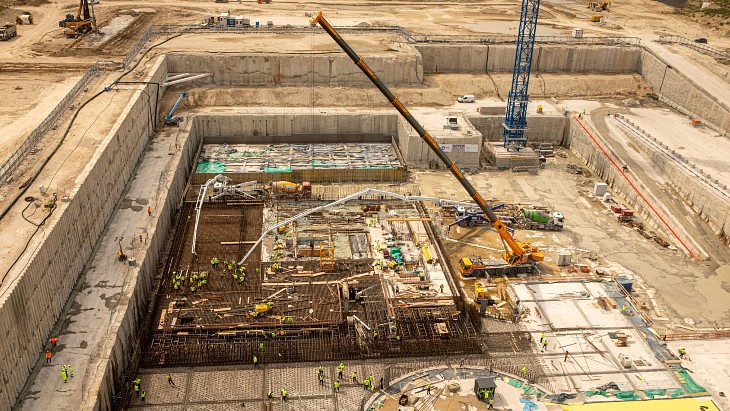
In a recent update from the project company for the deployment of two new Russian VVER-1200 reactor units, Paks II said: “Soil milling machines, crawler excavators, bulldozers and trucks are working on the construction of the unit 6 pit, which measures 150 metres in width, 190 metres in length, and 23 metres in depth. More than half of the approximately 500,000 cubic metres of soil have already been removed. The anchoring of the so-called secant pile walls and the construction of the permanent fence are taking place in parallel with the soil removal.
“Based on the experience gained at unit 5, workflows have been optimised, increasing efficiency, work quality, and, not least, occupational safety. A geodetic and geotechnical monitoring system is also in operation at the construction site, enabling the early detection of any impacts that may arise during execution.
“The excavation is progressing according to schedule, and the work is regularly inspected on-site by the Hungarian Atomic Energy Authority.”
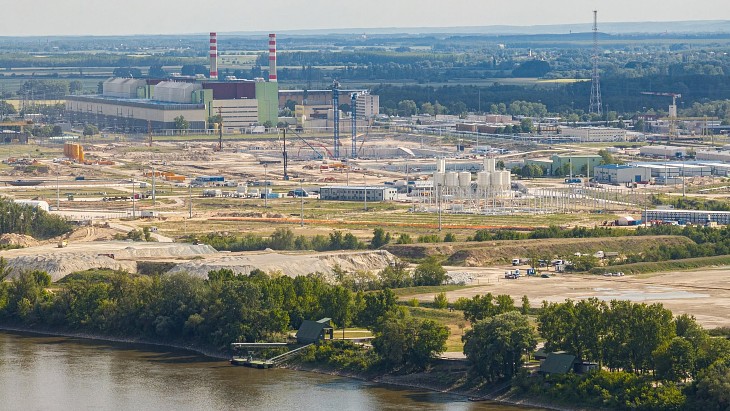
An aerial view of the project site (Image: Paks II)
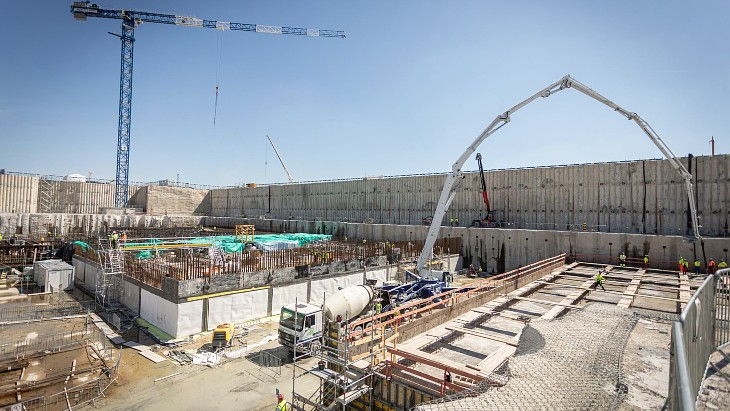
Concreting work has been continuing for unit 5 in June (Image: Paks II)
(Image: Paks II)
Last month, the new Hungarian Prime Minister Peter Magyar’s government announced a review of “the status of the Paks Nuclear Power Plant’s operating life extension and the contracts for the Paks II project, as well as the entire investment process”. During the election campaign he had suggested the price agreed for the new units was too high. Russia’s Rosatom said it was ready to answer all questions about the project and its costs, with the new government.
Among other on-going works relating to the project are preparatory work for the foundations of a new training centre, with structural works expected to reach ground level by the end of 2026, with completion by August 2027. The technical handover process and installation of simulators to take place a year later, Paks II says.
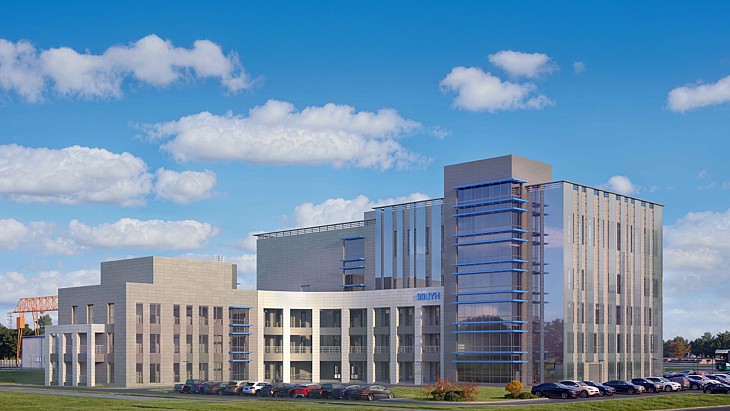
How the training centre could look (Image: Paks II)
The training centre is due to be six-storeys with 15,000 square metres of floor space providing theoretical and practical training of the operating staff including field operators, control room staff, as well as refuelling machine operators and maintenance staff.
Background
The Paks plant, 100 kilometres south of Budapest, currently comprises four Russian-supplied VVER-440 pressurised water reactors, which started up between 1982 and 1987. An inter-governmental agreement was signed in early 2014 for Russian enterprises and their international subcontractors to supply two VVER-1200 reactors at Paks as well as a Russian state loan of up to EUR10.0 billion (USD10.5 billion) to finance 80% of the project.
The construction licence application was submitted in July 2020, the licence was issued in August 2022, and a construction timetable was agreed in 2023, with a target to connect the new units to the grid at the beginning of the 2030s. The Hungarian Atomic Energy Authority issued permits in November for first concrete pouring for the foundation of what will be Paks unit 5, with first concrete being poured in February.
The project is the first Russian nuclear energy construction project started in a country while it is a member of the European Union, and is taking place despite sanctions targeting Russia. It is the first pouring of first concrete for any nuclear energy unit in the European Union since first concrete was poured in the then EU member country, the UK, for Hinkley Point C unit 2 in December 2019.