The milestone moment comes seven months after the reactor pressure vessel was installed in the first unit – which Rosatom Director General Alexei Likhachev said reflected the accelerated pace of progress on the project.
According to a report of the event on the Egyptian government’s Facebook account, Likhachev said the next stage of work would be the welding of pipelines for the reactor’s main cooling system.
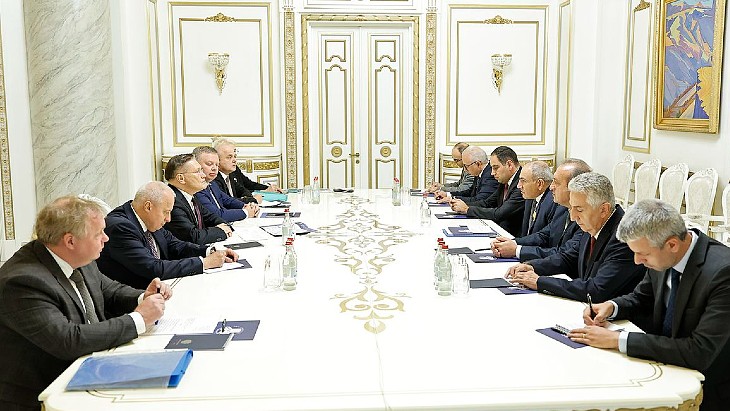
Egypt’s Prime Minister, Mostafa Madbouly, was among those attending the event, alongside International Atomic Energy Agency Director General Rafael Mariano Grossi, pictured below.
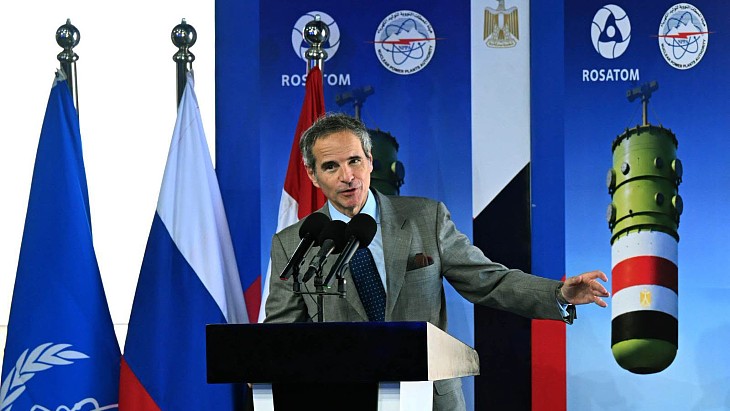
(Image: Egyption government/Facebook)
The 330-tonne reactor vessel is about 13 metres long and 4.5 metres in diameter. The service life is for an initial 60 years, with possible extension to 80 years. It was delivered from Volgodonsk in Russia to El Dabaa in May as part of what Rosatom called the .
The cylindrical steel reactor vessel, which houses the reactor core, ensures a hermetic seal and withstands high pressures and temperatures, ensuring the safety and reliability of the power unit.
Background
El Dabaa will be Egypt’s first nuclear power plant, and the first in Africa since South Africa’s Koeberg was built nearly 40 years ago. The Rosatom-led project, about 320 kilometres north-west of Cairo, will comprise four VVER-1200 units, like those already in operation at the Leningrad and Novovoronezh nuclear power plants in Russia, and the Ostrovets plant in Belarus.
Under the 2017 contracts, Rosatom will not only build the plant, but will also supply Russian nuclear fuel for its entire life cycle, including building a storage facility and supplying containers for storing used nuclear fuel. It will also assist Egyptian partners in training personnel and plant maintenance for the first 10 years of its operation. Rosatom has said it is aiming for a future service life of up to 100 years for nuclear power plants.
The four units are being built almost concurrently, with first concrete at unit 1 in July 2022, followed in turn by the others, concluding with first concrete at unit 4 in January 2024. Egypt’s aim is for 9% of electricity to be generated by nuclear by 2030, which would be achieved by the commercial operation of the first two units by that time, directly displacing oil and gas.