Monday, 31 March 2025
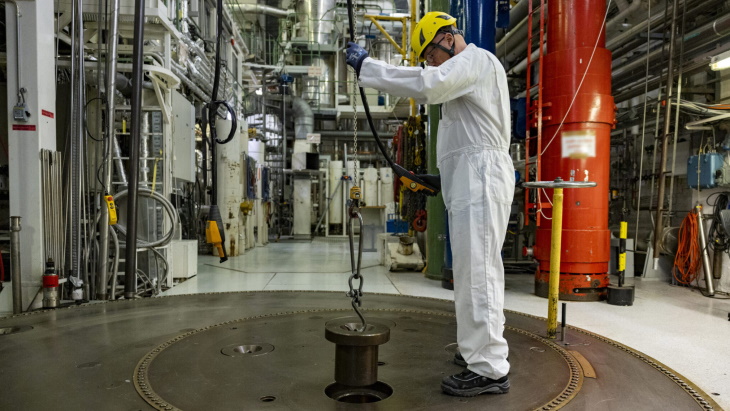
Established as an agency under the Ministry of Trade, Industry and Fisheries in February 2018, Norwegian Nuclear Decommissioning (NND) is responsible for decommissioning the research reactors and other related nuclear infrastructure, as well as the safe handling, storage and disposal of radioactive waste.
NND submitted an application in December 2022 for a licence to own and operate the two Norwegian nuclear facilities in Halden and Kjeller, as well as the operation of the waste landfill for low- and intermediate-level radioactive material in Himdalen. The current licence holder is the Institute for Energy Technology (IFE).
Norway’s two research reactors – the nuclear fuel and materials testing reactor at Halden and the JEEP-II neutron scattering facility at Kjeller – were declared permanently shut down by IFE in June 2018 and April 2019, respectively.
The transfer of the licence for Halden from IFE to NND was approved earlier this month by the Norwegian Radiation and Nuclear Safety Authority.
The government has now granted the licence, which is valid from 1 April for an unlimited period, “but with the possibility of revocation”.
“The licence includes the right to own, store, process, transport, possess and place nuclear material,” the government noted. “The licence also includes the right to trade nuclear material, but only to the extent necessary to return irradiated fuel to the client or owner in accordance with return agreements previously entered into by IFE or that will be entered into by NND in the future. The licence does not include the right to export nuclear material out of the country … If it becomes relevant at a later date, NND may apply for a permit for this.”
The Halden reactor – which started up in 1959 – ran at a maximum power of 25 MWt and contained numerous test positions, thus providing flexible test conditions. The project was a joint undertaking of national organisations in 19 countries sponsoring a jointly financed programme under the auspices of the OECD Nuclear Energy Agency. The programme was financed by the participating countries and was renewed every three years. As the host country, Norway covered about 30% of the programme cost. In June 2018, IFE announced it would not apply to extend the reactor’s operating licence, which expired in 2020, and the reactor, which was offline due to a safety valve failure, would not be restarted.
“This is a historic day,” said NND Director Pål Mikkelsen. “Today we celebrate that we have reached an important milestone. At the same time, the work has just begun, and we have many exciting tasks ahead of us.
“Both NND and IFE will independently ensure the safety of their respective facilities. At the same time, we will continue our close and good cooperation. Partly to help each other in general, but also to facilitate a successful transfer of nuclear facilities in Lillestrøm and in Aurskog-Høland when the time comes.”
NND said that since 2018 it has been “working on planning, licensing applications and preparing its own organisation to take over responsibility for Norway’s historic nuclear facilities. Today’s decision is the first part of the state taking over responsibility for all facilities associated with Norway’s historic nuclear research programme”.