

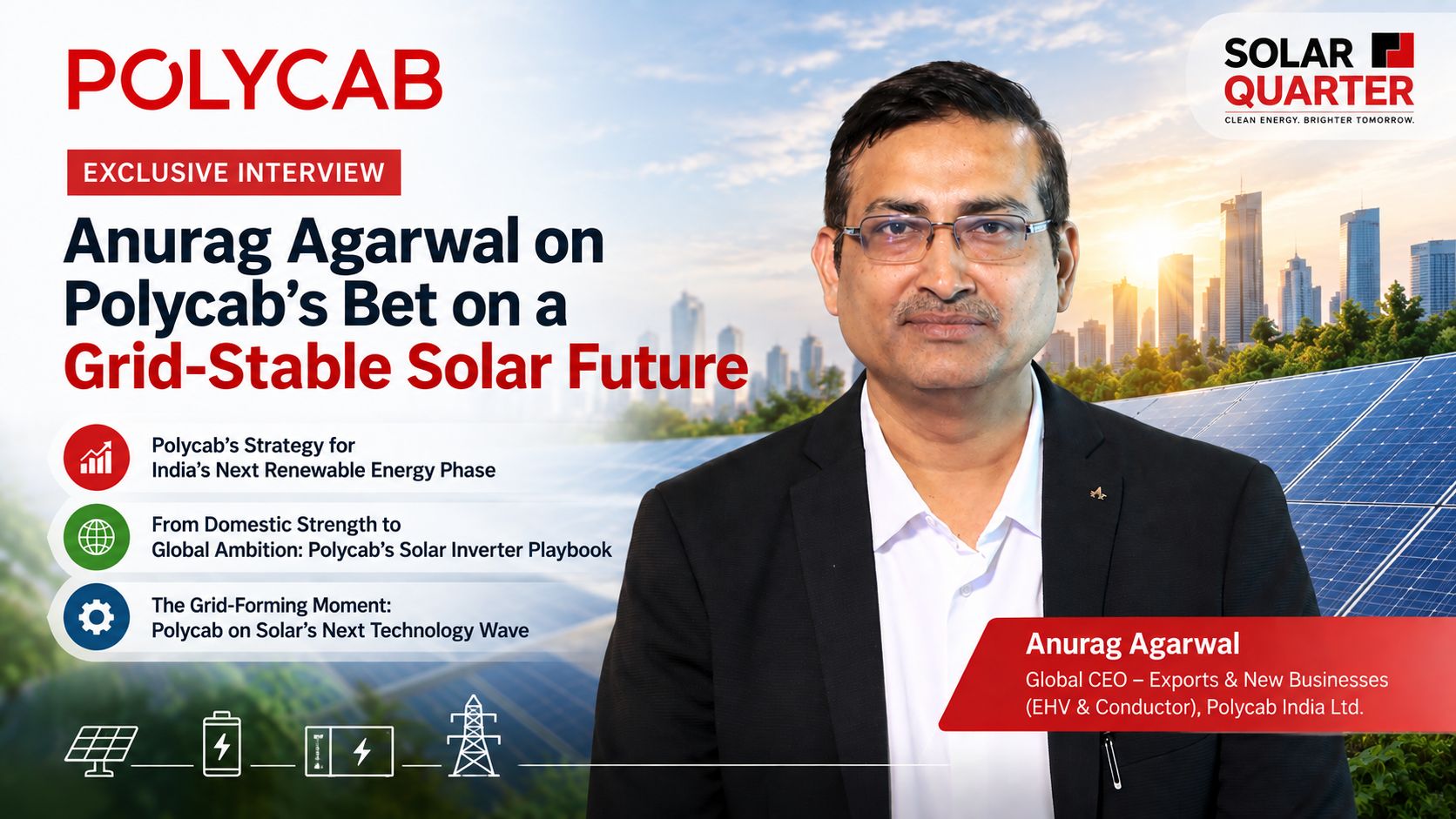
As India’s solar sector moves beyond capacity addition toward grid stability, reliability, and intelligent energy management, inverter and storage technologies are taking on an increasingly important role. Sharing his perspective with SolarQuarter, Anurag Agarwal, Global CEO – Exports & New Businesses (EHV & Conductor), Polycab India Ltd., discusses the evolution of solar inverter technology, Polycab’s growing focus on hybrid and grid-forming inverters, BESS, and smart monitoring, and the company’s strategy to leverage its domestic strength and global presence for the next phase of renewable energy growth.
1. How do you see solar inverter technology evolving in India’s renewable energy journey, and what opportunities does Polycab see in this growing market?
India’s solar sector has reached a major milestone, crossing 162 GW of capacity on our way to the 500 GW target by 2030. But as more solar power connects to the grid, the main challenge is changing: it is no longer just about adding capacity, but ensuring the power is reliable, stable, and available when needed.
Inverters are at the center of this shift. They are moving beyond basic power conversion to active grid management. The market is rapidly adopting Hybrid Inverters, Grid-Forming (GFM) Inverters, and Battery Energy Storage Systems (BESS) that help keep the grid stable when solar generation fluctuates.
At Polycab, we see this as a key growth area. We have already introduced our Hybrid Inverter range and are investing in storage-ready designs and smart monitoring tools. Our goal is to help our commercial, industrial, and utility customers get the highest return on their solar investments while meeting their long-term clean energy targets.
2. How does Polycab’s solar inverter portfolio address customer expectations around efficiency, reliability, grid compatibility, and long-term performance?
Anyone investing in a solar power system is making a 20- to 25-year financial commitment. They want four straightforward things: maximum power generation, dependable daily operation, smooth grid connection, and confidence in long-term equipment performance.
We build our inverter lineup directly around these needs:
• High Generation Yields: We use multi-MPPT designs and efficient Silicon Carbide (SiC) power electronics to extract maximum energy from panels, even in low light or partial shade.
• Built for Indian Conditions: Our String Inverters and Hybrid Inverters are built with heavy-duty thermal management and protective enclosures to handle extreme heat, dust, and humidity without losing performance.
• Grid Compatibility: They meet strict national grid standards, supporting active power control and handling voltage drops smoothly without shutting down.
• Backed by Service: Reliable hardware is only the first step. We back every installation with real-time remote monitoring software and Polycab’s service team across the country, ensuring long-term peace of mind.
3. As Global CEO overseeing exports and new businesses, what opportunities do you see for Indian solar solutions globally, and how is Polycab preparing to capture them?
Globally, energy security, rising power costs, and sustainability commitments are driving big changes. Governments, utilities, and major businesses everywhere are looking for trustworthy partners who can supply reliable clean energy infrastructure and electrical power products.
This creates a strong opportunity for India. With our engineering expertise and expanding manufacturing footprint, Indian companies are increasingly trusted as primary suppliers as global supply chains diversify.
Polycab is in a strong position to leverage this foundation. We already export our core electrical and power products to more than 94 countries, giving us deep experience with international power standards, global compliance, and varied operating conditions.
While solar inverters are currently established in our domestic portfolio, our global presence provides the perfect springboard. As we build out our international solar channels, we plan to take our complete range—including String Inverters, Hybrid Inverters, and BESS—to our global markets, backing them with the same quality and service support we deliver across our existing product lines.
4. Looking ahead, which emerging technologies do you believe will have the greatest impact on the solar industry, and how is Polycab preparing for this next phase of growth?
The solar industry is moving past basic generation—the big focus now is power availability and grid stability. As more renewable power comes online, traditional grids need help staying balanced. That is why technologies like Grid-Forming (GFM) Inverters, Hybrid Inverters, Microinverters, and BESS (Battery Storage) will have the largest impact over the coming years.
Unlike traditional inverters that simply follow grid signals, Grid-Forming Inverters actively set voltage and frequency, helping stabilize the power network during demand spikes or sudden weather changes. At the same time, automated fault diagnostics and smart monitoring software are helping plant operators fix issues early and reduce downtime.
At Polycab, we are actively preparing for this next wave. We have launched our Hybrid Inverter range and continue to invest in storage-ready platforms, Grid-Forming controls, and smart energy monitoring platforms. We want to make it easy for our customers to build intelligent, storage-integrated energy setups that protect their power supply and deliver solid financial returns for decades.
Subscribe to get the latest posts sent to your email.









)