The unit, which will be the fifth at the site in Russia’s Sverdlovsk region, will become the world’s largest fast-neutron reactor.
The sodium-cooled BN-series fast reactor plans are part of Rosatom’s project to develop fast reactors with a closed fuel cycle whose mixed-oxide (MOX) fuel will be reprocessed and recycled. In addition to the BN-600 reactor at Beloyarsk unit 3, which began operation in 1980, the 789 MWe BN-800 fast reactor at Beloyarsk unit 4 entered commercial operation in October 2016. This is essentially a demonstration unit for fuel and design features for the larger BN-1200, which will be unit 5 at Beloyarsk.
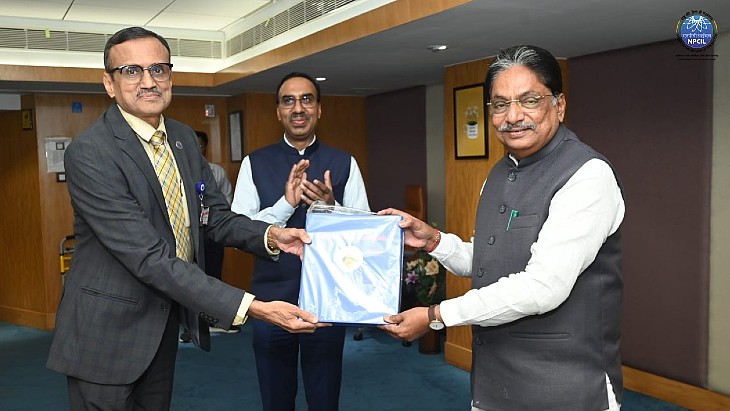
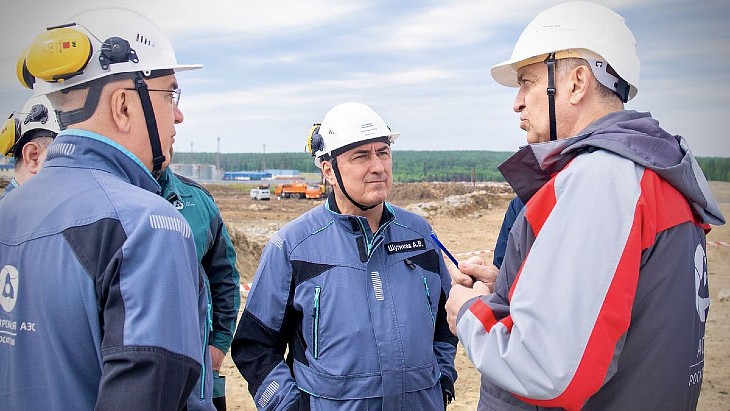
Details of the proposed construction timelines came during a visit to the site by Rosenergoatom CEO Alexander Shutikov (see picture above), where he heard that 1.4 million cubic metres of waste soil and vegetation have been cleared from the site.
Site preparation for drilling and blasting operations and site planning are scheduled to be ready this summer, reported Yuri Nosov, director of the power plant.
And Shutikov said: “Our primary focus now is completing the design documentation for submission to the Main Directorate of State Expertise of Russia, with the goal of receiving a conclusion on the design documentation for the main construction period by the end of 2026. The next step is to obtain a licence to construct the power unit in the spring of 2027.”
He said the target for first concrete was by the end of 2027. When the preliminary phase for construction of the unit was launched in July last year by Rosatom Director General Alexei Likhachev, 2034 was reported as the target date for completion.
Rosatom says the service life of the BN-1200 power unit will be at least 60 years. Its design uses technical solutions that have proven themselves in the operation of the BN-600 and BN-800 reactors, but also features innovations. For example, the BN-1200 will have four instead of three loops for the circulation of liquid sodium, like its predecessors; the volume of the in-reactor storage facility will be increased to allow the unloading of fuel assemblies from the reactor directly into the used fuel pool, eliminating the intermediate drum for used assemblies; and the turbine condensers will be cooled using a chimney-type evaporative cooling tower.
In April last year Russia’s nuclear regulator Rostechnadzor gave the go-ahead for the BN-1200 reactor. The licence was issued after the consideration of a package of documents covering the safety of the power unit and its compliance with technical regulations, federal rules and standards and legislation, Rosatom said.
It says that the fourth generation units “have the potential to radically transform the nuclear energy industry, primarily through a new level of safety, an expanded fuel mix, and a significant reduction in radioactive waste” and contributing to a closed nuclear fuel cycle.