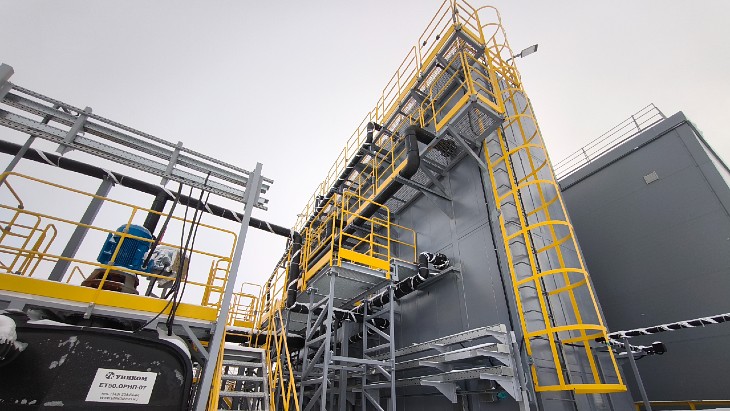
JSC Dalur, part of Russian state nuclear corporation Rosatom’s mining division, has built Operation Unit U-14V at the deposit, which includes a mobile sorption unit which is described as “a high-tech complex of modular containers: sorption columns, solution and sorbent tanks, an electrical substation, and a control room. The facility includes nearly 2,000 metres of process pipeline overpasses and utility networks, as well as fire-fighting tanks with a total capacity of 120 cubic metres”.
The mobile sorption unit can be relocated between sites rapidly and is focused on remote areas, with Rosatom saying its main advantages are “mobility, rapid commissioning, and a significant reduction in capital expenditures compared with traditional stationary facilities”.
The compliance certificate was issued by the Ural Interregional Territorial Administration for Supervision of Nuclear and Radiation Safety, which is part of Rostekhnadzor. Rosatom said the final inspection “confirmed that all construction and installation stages were completed in strict compliance with approved technical regulations and industrial safety standards”.
Dinis Ezhurov, CEO of Dalur JSC, said: “The next stage of deposit development will be the commissioning of the new production unit. Equipped with cutting-edge equipment, this unit will enable us to maintain the required uranium production volumes for the needs of Russia’s nuclear energy sector, effectively developing hard-to-reach areas of the deposit. At the same time, we strictly adhere to the highest environmental and industrial safety standards, implementing the principles of responsible subsoil use.”
Dalur was the first company in Russia to mine uranium using the in-situ recovery (ISR) method – also known as in-situ leaching (ISL). It involves minerals being recovered from ore in the ground by dissolving them in situ, using a mining solution injected into the orebody.
The solution is then pumped to the surface, where the minerals are recovered from the uranium-bearing solution. More than half of the world’s uranium production is now produced by such methods.
Rosatom described it as the most environmentally-friendly mining method and said it had been developed by Dalur in collaboration with other mining division companies – it was tested at the deposits of JSC Khiagda, in the Republic of Buryatia.