Kazakhstan nuclear power plant project moving ahead

Wednesday, 26 February 2025
Kazakhstan nuclear power plant project moving ahead
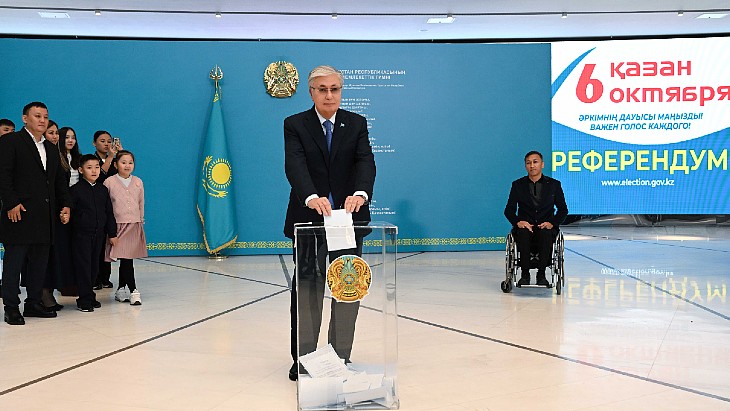
President Kassym-Jomart Tokayev casting his referendum vote in October (Image: President’s office)

According to a decree officially published on the Minister of Justice’s website, a government decision was made on 30 December on the construction area, with the resolution entering into force “on the day of its first official publication”.

Kazakhstan has well-developed plans for new nuclear, with more than 71% of people who voted in a referendum in October answering yes to the question: “Do you agree with the construction of a nuclear power plant in Kazakhstan?”

In an update on Wednesday, the Ministry of Energy reported that Energy Minister Almassadam Satkaliyev said a national strategy for the nuclear industry up to 2050 was under development. He added that, following the decision on the proposed facility’s location, in 2025 “it is planned to select a technology supplier (or consortium) for the construction of a nuclear power plant, as well as conclude an intergovernmental agreement and relevant contracts”.

There are reported to be four technology suppliers being considered – China National Nuclear Corporation (HPR-1000), France’s EDF (EPR1200), Korea Hydro and Nuclear Power (APR-1000/APR-1400) and Russia’s Rosatom (VVER-1200 reactor).

Background
 

Kazakhstan is the world’s leading producer of uranium. Although it does not currently use nuclear energy, it is not without nuclear experience: it has three operating research reactors, and a Russian-designed BN-350 sodium-cooled fast reactor operated near Aktau for 26 years, until 1999.

Kazakhstan has been preparing for a possible nuclear power programme to reduce its reliance on fossil fuels, diversify its energy mix and reduce CO2 emissions for some time. Kazakhstan Nuclear Power Plant (KNPP), a subsidiary of Kazakhstan’s Samruk-Kazyna National Welfare Fund JSC, was set up in 2014. As well as being designated as the owner/operator of a future plant, KNPP is tasked with pre-project work including a feasibility study to justify the need for nuclear power – carried out in 2018 – and locating a site.

A site at Ulken, on the shores of Lake Balkhash, has been identified as the most suitable location. The proposed first nuclear power plant would be a large reactor but there are also options for using small modular reactors to replace retiring coal plants in the years to come and a second large plant is being considered with the government’s target being for nuclear to produce a 5% share of the national generation mix by 2035.
   

  • Related Posts

    Application lodged to build microreactor at US university

    The (CPA) was submitted on 31 March by The Grainger College of Engineering at the University of Illinois Urbana-Champaign, NANO Nuclear Energy Inc’s partner for the KRONOS MMR deployment at…

    Growing recognition of nuclear fuel cycle’s importance, WNFC hears

    Speakers at the event co-organised by the Nuclear Energy Institute and World Nuclear Association highlighted the challenges and opportunities at a time when geopolitical uncertainty means nuclear energy – underpinned by…

    Have You Seen?

    TSMC warns of gas cost pressures as AI demand outpaces chip supply

    • April 16, 2026
    TSMC warns of gas cost pressures as AI demand outpaces chip supply

    India’s Cooking Gas Crisis Could Persist for Years

    • April 16, 2026
    India’s Cooking Gas Crisis Could Persist for Years

    Iran-Linked Tankers Test Limits of U.S. Hormuz Blockade

    • April 16, 2026
    Iran-Linked Tankers Test Limits of U.S. Hormuz Blockade

    India Snaps Up Spot LNG Cargoes as Asian Prices Slide

    • April 16, 2026
    India Snaps Up Spot LNG Cargoes as Asian Prices Slide

    ‘No market’: Bosch Chairman urges EU to boost hydrogen demand, ease rules

    • April 16, 2026
    ‘No market’: Bosch Chairman urges EU to boost hydrogen demand, ease rules

    EU electricity relief for energy-intensive firms in Germany Bulgaria and Slovenia

    • April 16, 2026
    EU electricity relief for energy-intensive firms in Germany Bulgaria and Slovenia

    EU electricity relief for energy-intensive firms in Germany Bulgaria and Slovenia

    • April 16, 2026
    EU electricity relief for energy-intensive firms in Germany Bulgaria and Slovenia

    Bromine supply risk ‘more dangerous’ than helium for chip industry

    • April 16, 2026
    Bromine supply risk ‘more dangerous’ than helium for chip industry

    Uzbekistan’s $6bn project tests region’s leap into industrial-scale hydrogen fuels

    • April 16, 2026
    Uzbekistan’s $6bn project tests region’s leap into industrial-scale hydrogen fuels

    Video | Managing contamination risk in helium compression systems

    • April 16, 2026
    Video | Managing contamination risk in helium compression systems