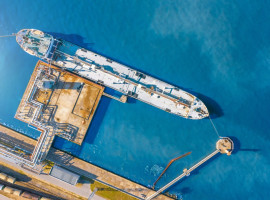
Industrial gas major Messer and Ambrian Energy have received European Commission antitrust approval for their CarbonBridge joint venture. This clears the way for development of Germany’s first operational carbon dioxide (CO2) export terminal in Bremen.
The terminal is scheduled to begin operations as early as 2031, with an initial CO2 handling capacity of approximately 2.3 million tonnes per year. The partners plan to increase this to around four million tonnes annually as demand develops.
CarbonBridge will provide CO2 logistics services including temporary storage, transport and loading, with the terminal designed to connect carbon-intensive industries with permanent storage sites in the North Sea.
The infrastructure will target captured CO2 from industries including cement, glass and steel production, as well as waste incineration. The project is intended to provide a route for recovered CO2 to be transported from emitters to geological storage sites, supporting the development of carbon capture and storage (CCS) in Germany.
“We are very pleased with the antitrust approval for CarbonBridge, a project that underscores our commitment to implementing carbon capture utilisation and storage (CCUS) in Germany – covering the entire value chain from the CO2 source to the sink,” said Ralph Spring, Senior Manager Commercials CCUS at Messer.
“In most projects, the logistics involved in transporting CO2 to the final storage site are the biggest challenge. With CarbonBridge, we aim to offer a flexible solution.”
The project is being developed as a joint venture between Messer and Ambrian Energy.
Ambrian is contributing a three-hectare site in Bremen with an existing rail connection and a port berth capable of accommodating vessels of up to 30,000 tonnes. These connections will support the onward transport of captured CO2 to storage sites in the North Sea.
Daniel Pätzold, Managing Director of Ambrian Energy, said reliable export infrastructure would be needed by industrial companies seeking to decarbonise through carbon capture and storage.
“This is precisely the gap we aim to close with CarbonBridge,” he said. “The European Commission’s approval is therefore not only an important step for our project but also a strong signal for the development of a competitive carbon capture and storage infrastructure in Germany.”
Messer said CarbonBridge will also form part of its wider “ZeCarb” Carbon Capture as a Service offering, through which the company and its partners can manage the process from CO2 capture through to final storage.
Germany has been moving to establish the legal framework needed for cross-border CO2 transport, with proposed changes to its intended to facilitate exports and the development of offshore storage. The changes could open a route for captured CO2 from German industry to be transported to storage sites in countries such as Norway.