The conditional commitments are made through the Department of Energy (DOE) HALEU Allocation Process, under which “interested parties” – such as developers of advanced reactors – can request high-assay low-enriched uranium (HALEU) from DOE sources to meet near-term needs for the material.
Most advanced reactor designs need HALEU fuel, which contains between 5% and 20% uranium-235, but the material is not currently commercially available from US domestic suppliers – the existing nuclear fleet uses low-enriched uranium fuel, which contains up to 5% of the fissile uranium isotope. Gaps in supply could delay the deployment of advanced reactors. To address this, the DOE set up the HALEU Availability Program in 2020 to secure a domestic supply of HALEU for civilian domestic research, development, demonstration, and commercial use, which developed into the allocation process.
The allocations announced by the DOE on 23 July will support NASA’s SR-1 Freedom mission to Mars and Radiant’s deployment of a microreactor to the Air Force’s preferred location of Buckley Space Force Base in Colorado, DOE said. NASA is a first-time recipient of HALEU under the scheme, while Radiant has received a previous allocation to its Kaleidos demonstration reactor.
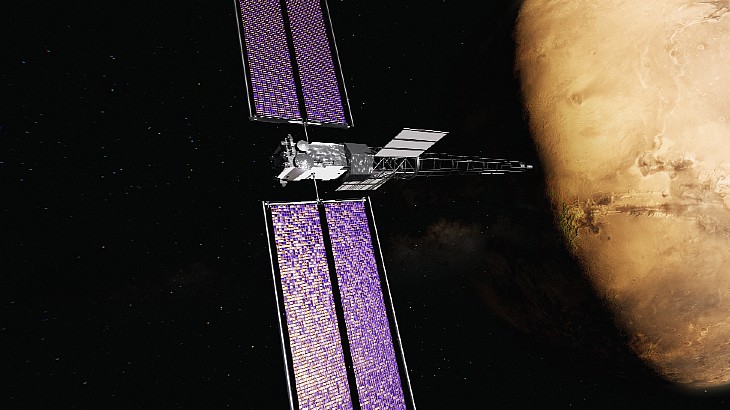
The SR-1 Freedom mission is described by NASA as the first nuclear-powered interplanetary spacecraft, and a pathfinder mission that will lay groundwork and develop technologies for future applications, including for surface power on the Moon and Mars and for outer solar system exploration. SR-1 – for Space Reactor-1 – will inform Lunar Reactor-1 (LR-1), a fission surface power system designed to keep NASA’s Moon Base operating through periods of darkness and in locations where solar power alone is not sufficient. Its HALEU-fuelled reactor, weighing about 12,000 kg, will provide 20 kW of electric closed Brayton cycle power conversion system. With a planned launch date of late 2028, the spacecraft will also carry the SkyFall payload of three Mars helicopters evolved from NASA’s heritage Ingenuity Mars Helicopter design.
Earlier this year, the Department of the Air Force selected Radiant, alongside Westinghouse Government Services and Antares Inc, as potential microreactor developers and operators under its Advanced Nuclear Power for Installations initiative. Radiant’s first Kaleidos high-temperature gas-cooled portable microreactor for the Buckley Space Force Base is scheduled for delivery in 2028.
Radiant – alongside TRISO-X, Kairos Power, Westinghouse Electric Company and TerraPower – was one of the first round of conditional selections announced by the DOE in April 2025. Three further selectees – Antares Nuclear, Standard Nuclear, and Abilene Christian University/Natura Resources – were announced the following August.
“This second HALEU allocation moves us a step closer to turning Buckley’s national security requirement for resilient power into an operational reality,” Radiant’s Chief Nuclear Officer Rita Baranwal said.
“Today’s allocations spotlight the importance of fueling advanced nuclear reactors for space exploration and national security,” Assistant Secretary for Nuclear Energy Ted Garrish said. “The US Department of Energy’s HALEU Availability Program is an important stepping-stone for the nuclear industry as we work to establish a domestic nuclear fuel supply in support of the American nuclear renaissance.”