Friday, 3 January 2025

The cylindrical reactor pressure vessel (RPV) – measuring 11.45 metres in length and 5.7 metres in width – was produced by the Volgodonsk branch of AEM-Technologies JSC of Atommash, part of Atomenergomash, the machine production division of Rosatom. The 350-tonne vessel was delivered by sea to the construction site in November 2023 and has since been held in storage.
The RPV has now been installed using the ‘open top’ method. This method allows large equipment to be loaded into the reactor building using a heavy-duty crane before the reactor dome is closed. It can significantly cut the time taken to carry out installation work.
Following the completion of the reactor pressure vessel assembly, a commission consisting of experts from Akkuyu Nuclear Inc. as well as independent auditing organisation Türk Loydu and the Turkish Nuclear Regulatory Authority carried out an inspection of the reactor vessel assembly quality.
“As in previous years, the dynamics of the field work in 2024 were very high,” said Sergei Butckikh, First Deputy CEO of Akkuyu Nuclear JSC. “We carried out the main operations envisaged in the project plan. The heart of the third power unit of Akkuyu NPP was established, that is, we successfully completed the critical work on the assembly of the nuclear reactor vessel.
“As with all other construction and installation operations on the site, the installation of the reactor vessel required meticulous preparation, highly qualified experts and special precision at every stage.”
The Akkuyu plant, in the southern Mersin province, is Turkey’s first nuclear power plant. Rosatom is building four VVER-1200 reactors, under a so-called BOO (build-own-operate) model. Construction of the first unit began in 2018. The 4800 MWe plant is expected to meet about 10% of Turkey’s electricity needs, with the aim that all four units will be operational by the end of 2028.
The RPVs of units 1 and 2 were installed in June 2021 and September 2022, respectively.
Fuel delivered for second unit
In late December, the nuclear fuel produced for unit 2 arrived at the Akkuyu site. The fuel assemblies – produced at the Novosibirsk Chemical Concentrator Plant, part of Rosatom’s fuel company TVEL – were delivered to the site in special transport containers and placed in the fresh fuel storage facility.
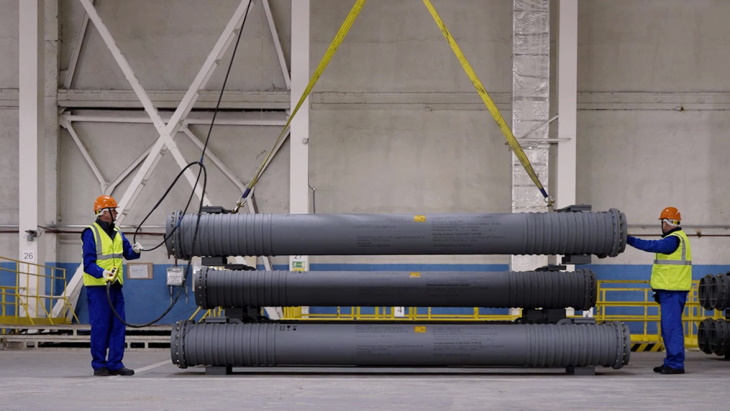
Fuel for Akkuyu unit 2 (Image: Akkuyu Nuclear)
“The fuel was transported to Turkey by land and sea in leak-proof containers under close coordination between the relevant units of Akkuyu Nuclear JSC, the production facility and the inspection authorities,” Butckikh said. “Before being loaded into the reactor, the containers will be kept under special conditions in the fresh fuel storage facility at the NPP site.”
One fuel load for the VVER-1200 reactor consists of 163 fuel assemblies containing uranium enriched to 5% uranium-235.
A ceremony was held in April 2023 to mark the arrival of the first fuel for unit 1 of the Akkuyu plant ahead of its expected start up later this year. The delivery of nuclear fuel marked the moment of Akkuyu officially becoming a nuclear power plant and also of Turkey being categorised as a country with nuclear energy capacity.