By
59 min ago 3 min read
Researchers in South Korea have developed a method for producing metal-organic frameworks (MOFs) at room temperature, potentially reducing the energy requirements associated with manufacturing materials used in carbon capture and gas separation.
Announcing the findings on 12 October, the Pohang University of Science and Technology (Postech) said a joint research team led by Professor Seo Dae-ha of its Department of Chemistry and Professor Jeong Nak-cheon of DGIST’s Department of Chemistry and Physics had developed a technique to synthesise MOFs in water at 25°C and atmospheric pressure using visible light.
The research was published in the international journal Advanced Materials.
MOFs are porous materials made from metal ions connected by organic molecules. Their cage-like structures contain tiny pores that can be tailored to capture particular molecules, making them of interest for carbon capture, gas separation and purification.
The technology could offer another route towards making these materials more efficiently as researchers seek to improve their performance and reduce the costs associated with manufacturing them.
Conventional MOF synthesis can involve energy-intensive heating and solvents that create additional environmental and handling challenges. The South Korean team’s approach instead uses copper(I) oxide nanoparticles and visible light to control crystal formation.
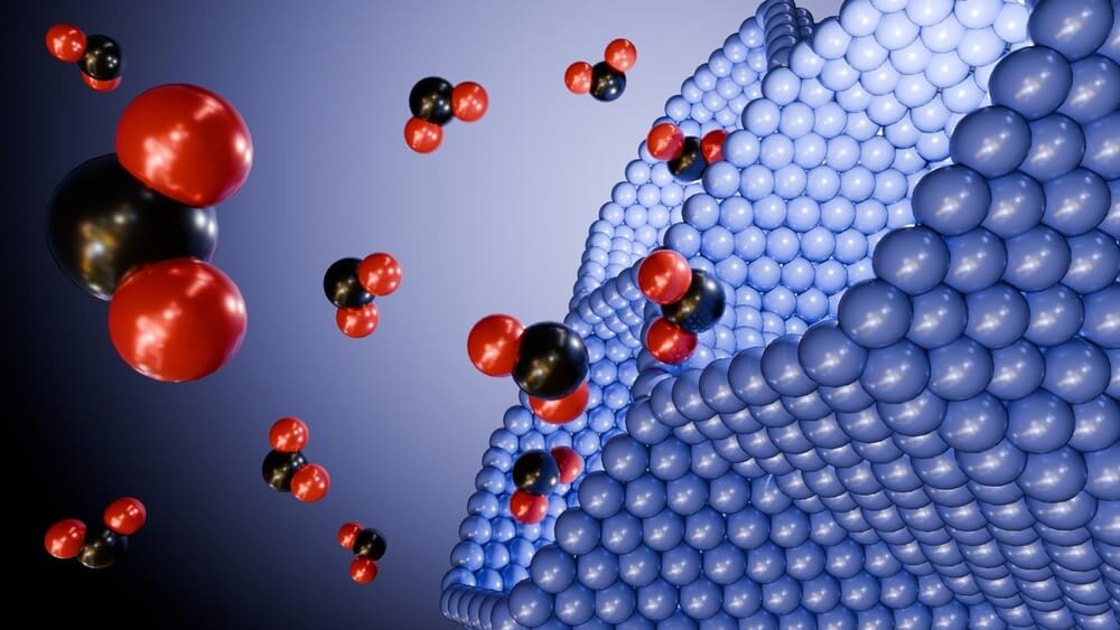
When illuminated, the nanoparticles release copper ions that react with surrounding organic molecules, forming a shell on the particle surface. This creates conditions that support the growth of MOF crystals.
The researchers demonstrated the technique using HKUST-1, a copper-based MOF, and found that changing the light intensity could also influence the resulting structure, including the formation of hollow materials.
Further work will be needed to establish whether the approach can be scaled up economically and how its overall energy consumption compares with established manufacturing processes.
The research comes amid wider efforts to make MOFs more practical for industrial applications, with teams exploring ways to improve both production methods and the materials’ performance.
In August, researchers at the University of Birmingham reported that a green-chemistry approach to producing a MOF for could improve resource efficiency and lower estimated production costs.
The team, led by Dr Swaroop Chakraborty, redesigned a processing step to recover more of the material. The resulting freeze-dried MOF removed more than 90% of lead from solution within the first hour, with high removal maintained across four consecutive treatment batches.
The researchers said they were seeking industrial partners in mining, electronic waste and water treatment to explore licensing opportunities.
Other research has focused on improving MOF performance in gas applications.
In April, a team led by the Korea Institute of Materials Science reported that increased the carbon dioxide adsorption capacity of MOFs by up to 75%. The technique used rapid heating and cooling to restructure defects and improve the materials’ pore structure.
The researchers also reported an increase in surface area of up to 94%, alongside improved selectivity for gas separation.
For the industrial gas sector, the potential lies in materials that could improve the separation or capture of gases such as CO2, while reducing the energy and processing requirements involved.