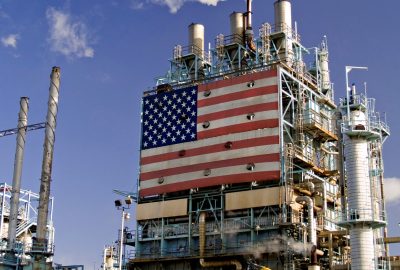
(Reuters) – U.S. tariffs on steel and aluminum imports are poised to escalate costs for the oilfield service companies behind North America’s vast energy industry, as their operations rely heavily on these metals.
Steel is essential for everything from the drilling rigs and pipelines to refineries and storage tanks provided by companies such as ChampionX and Patterson-UTI that supply the equipment and services necessary for oil-and-gas producers.
Any tariff hike is a potential hit to the operational and production costs of these businesses, half a dozen industry experts told Reuters.
U.S. President Donald Trump’s increased tariffs on all steel and aluminum imports took effect earlier on Wednesday “with no exceptions or exemptions”, escalating the global trade war.
“About 14% of what we buy, it comes from countries that will be impacted by tariffs,” said Patterson-UTI CEO Andy Hendricks. “If you layer on tariffs, it could affect us in the low single digits in terms of our costs going up for what we do,”
Peer ChampionX has also warned of equipment costs going up due to tariffs.
A particular variety of steel, hot-rolled coil steel (HRC), is used to fashion oil country tubular goods (OCTG) – specialized pipes and tubes designed to endure high pressures, temperatures and corrosive environments.
In 2024, the U.S. imported nearly 40% of its OCTG, according to Wood Mackenzie analyst Nathan Nemeth. By January 2025, Canada and Mexico accounted for 16% of OCTG imports, hinting at buyers stockpiling ahead of potential tariffs.
Broadly, U.S. imports of steel products from Canada and Mexico in January rose more than 32% from the previous month to 1,017,644 metric tons, U.S. Census Bureau data showed.
Rystad Energy expects tariffs to spike OCTG costs by 15% year-on-year. U.S. prices of HRC are estimated to ascend to $890 per short ton in 2025, marking a 15% increase from the previous year’s average price, according to S&P Global Commodity Insights analyst Ali Oktay.
“It’s probably going to be harder for service companies in 2025 to maintain their activity levels and their pricing,” said Mark Chapman, principal analyst for OFS Intelligence at Enverus.
Shares of Patterson-UTI and ChampionX have dropped about 16% and 3.3%, respectively, since Trump on February 11 announced plans to hike duties on steel and metal imports.
Chapman sees costs rising for Halliburton as well as firms like NOV and Tenaris, key providers of steel pipes to the petroleum industry.
While Halliburton and NOV did not respond to requests for comment, Tenaris said it was monitoring the potential impact of tariffs.
This price surge will likely be passed on to customers who operate in the exploration and production segment, particularly smaller-scale producers who are more exposed to spot market pricing.
“OCTGs represent about 8.5% of drilling and completion costs for onshore wells in the Lower 48 states. So if prices rose by 25%, about 2.1% would be added to well costs,” Wood Mackenzie’s Nemeth said.
Average well costs for producers in the U.S. typically range from $8 million to $9 million.
“They’re (small-cap producers) at the mercy of the service providers,” Chapman said. Large-scale producers such as Exxon Mobil, ConocoPhillips, EOG Resources and Diamondback, with their robust balance sheets and diversified supply chains, are better equipped to absorb these costs.
The tariffs come amid plummeting oil prices, the lowest since Russia’s invasion of Ukraine disrupted supply chains. Trump’s wish to achieve cheaper oil prices and increased production might not align with the profitability of producers.
Further, Venture Global, Energy Transfer and Williams Companies all warned in regulatory filings that tariffs could raise project costs, particularly construction costs related to foreign-sourced materials such as steel and aluminum.
Reporting by Vallari Srivastava in Bengaluru, writing by Mrinalika Roy; Editing by Stephanie Kelly, Matthew Lewis and Devika Syamnath
Share This:
More News Articles