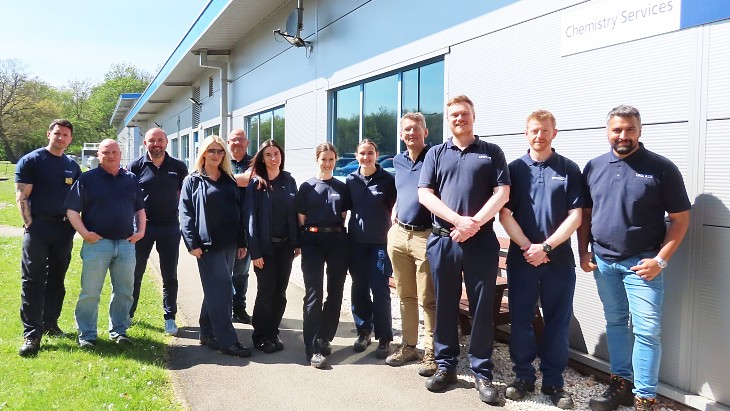
Low-enriched uranium plus (LEU+) is uranium enriched to between 5% and 10% U-235. The production trial took place over five days to 1 May, following permission from the Office for Nuclear Regulation, achieving samples at 7%.
Magnus Mori, Head of Advanced Fuels, Commercial for Urenco, said: “Urenco is committed to enriching uranium for the reactors of today and tomorrow. This production trial of LEU+ at Capenhurst has provided a successful outcome and demonstrates our commitment to advancing the nuclear industry in the UK and globally. We are continuing to focus on implementing other operational measures for LEU+, including transport solutions, as a next step.”
The nuclear fuel cycle
Unenriched, or natural, uranium contains about 0.7% of the fissile uranium-235 (U-235) isotope. (“Fissile” means it’s capable of undergoing the fission process by which energy is produced in a nuclear reactor). The rest is the non-fissile uranium-238 isotope. Most nuclear reactors need fuel containing between 3.5% and 5% U-235. This is also known as low-enriched uranium, or LEU. Advanced reactor designs that are now being developed – and many small modular reactors – will require higher enrichments still. This material, containing between 5% and 10% U-235 – is known as LEU+, with that from 10% to 20% U-235 known as high-assay low-enriched uranium, or HALEU.
Enrichment increases the concentration of the fissile isotope by passing the gaseous UF6 (uranium hexafluoride) through gas centrifuges, in which a fast-spinning rotor inside a vacuum casing makes use of the very slight difference in mass between the fissile and non-fissile isotopes to separate them. As the rotor spins, the concentration of molecules containing heavier, non-fissile, isotopes near the outer wall of the cylinder increases, with a corresponding increase in the concentration of molecules containing the lighter U-235 isotope towards the centre.
Enriched uranium is then reconverted from the fluoride to the oxide – a powder – for fabrication into nuclear fuel assemblies.
The need for LEU+
The use of LEU+ fuel can support longer operating cycles for current light-water reactors and also can help with the deployment of new accident-tolerant fuel designs.
Urenco says that LEU+ can also be used by advanced reactor designs which require HALEU as they will be able to “utilise LEU+ initially to speed up deployment timelines”. It adds that LEU+ can also serve as feedstock for producing HALEU, increasing the potential output of future HALEU enrichment facilities.
The next steps
Urenco’s US division produced its first LEU+ fuel in December and Urenco says that it plans to make LEU+ commercially available from the UK “in the near future”, which will support the existing US capability. It says LEU+ could be transported to fabricators from early 2027 to complete the next stage of the fuel cycle.
The UK project received support from the Department for Energy Security and Net Zero’s Nuclear Fuel Fund.