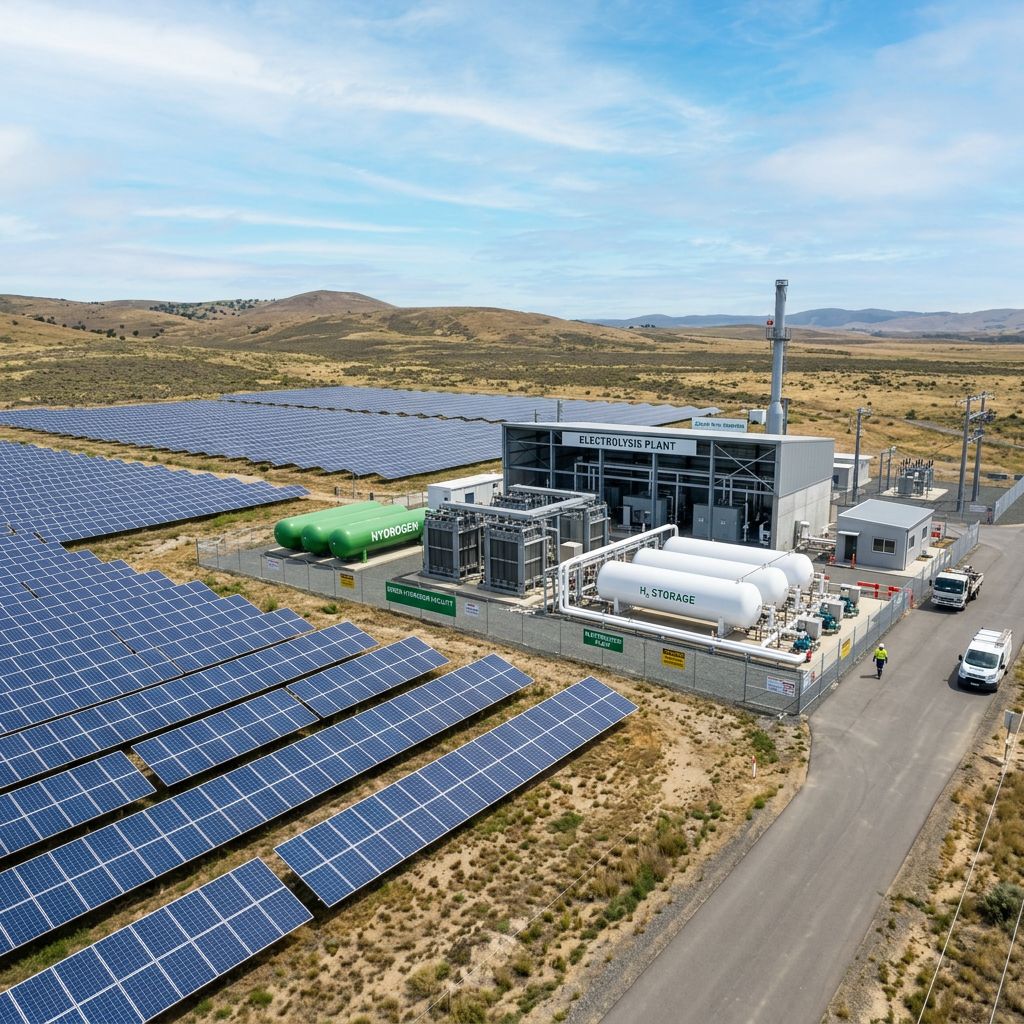
Scientists at the Fraunhofer Institute for Solar Energy Systems (ISE) have developed a new photovoltaic-electrolysis module that can produce green hydrogen directly from sunlight with very high efficiency. The innovation combines solar power generation and water electrolysis into a single integrated system, offering a promising solution for future renewable hydrogen production.
Hydrogen is considered one of the key clean fuels for the future because it can be used in industries, transportation, and energy storage without producing carbon emissions when generated using renewable sources. However, conventional hydrogen production through electrolysis requires electricity from an external power source to split water into hydrogen and oxygen. This additional power conversion process can reduce overall efficiency and increase system complexity.
The Fraunhofer ISE research team has addressed this challenge by directly connecting advanced photovoltaic cells with proton exchange membrane (PEM) electrolysis cells. Instead of first converting solar energy into electricity and then supplying that electricity to a separate electrolyzer, the new system uses the electricity generated by the solar cells immediately for hydrogen production. This direct connection eliminates intermediate power conversion stages and reduces energy losses.
The technology is based on concentrating photovoltaics, where a Fresnel lens array focuses sunlight onto highly efficient III-V multi-junction solar cells. These solar cells are known for their exceptional performance and long-term reliability and are already widely used in space applications. Under concentrated sunlight, the cells generate an open-circuit voltage of more than four volts, making them well suited for directly driving the electrolysis process.
In the developed system, the high-voltage solar cells are directly connected to the cathode and anode of two PEM electrolysis cells connected in series. This creates an excellent electrical match between the solar cells and the electrolyzer, allowing efficient conversion of solar energy into hydrogen without requiring additional electronic components.
To evaluate the technology, the researchers built a small outdoor demonstration system with a lens area of 64 square centimetres. During testing, the prototype achieved a solar-to-hydrogen conversion efficiency of up to 31.3 percent, calculated using the higher heating value of hydrogen. According to the researchers, this represents one of the highest efficiencies ever achieved for direct solar hydrogen production.
Although the results are highly encouraging, the technology is still at an early stage of development. The research team believes additional work is needed before the system can be commercialized on a large scale. To accelerate development and bring the technology closer to market, the researchers are seeking investors to support the launch of their planned spin-off company, Clearsun Energy. If successfully scaled, the innovation could play an important role in advancing clean hydrogen production and supporting the global transition to renewable energy.
Subscribe to get the latest posts sent to your email.